Almost all medical providers will recognise the scenario of being asked by an organiser how much medical provision a particular event will need, after being given only a very few pieces of information – usually how many people they are expecting.
For quite a few years, the answer was almost always based on a quick look a reference table. This was mostly taken from different versions of the “Purple Guide”.
The Purple Guide
The Purple Guide was first created after a mass-casualty incident at the 1988 running of the “Monsters of Rock” festival at Donington Park motor racing circuit.
Originally published by the Health and Safety Executive as HSG195, The UK Event Safety Guide, over two editions, it was taken over by the industry as the Purple Guide to Health, Safety, and Welfare at Music and Other Events.
In all its editions, it has focused on predominantly large-scale gatherings like music festivals – always being outdoor events, and specifically being targeted at event organisers, rather than medical providers, covering everything from toilets, to queuing, and of course medical cover.
The HSE editions of the book used a scoring system, where points would be added up from categories including expected numbers of people (from 1 to 58 points), the nature of the event (2 to 9 points), and time of year (1 or 2 points).
Once added up, these points gave a total score, and there was a quick reference table of the number of ambulances, first aiders, doctors, and so on that were needed.
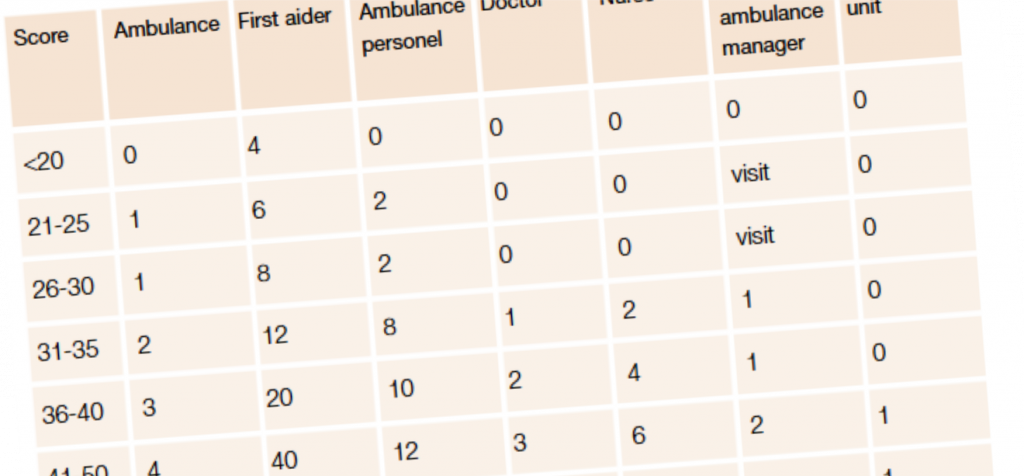
Later versions used a tiered approach, and recommendations based largely on the number of people, whilst the NHS ambulance service NARU unit kept publishing a version of the original HSE table, which was different to the ‘official’ purple guide.
These quick-reference tables were quick, and helped organisers and providers to easily compare the cover they are “supposed” to have.
So why don’t reference tables work?
If tables are quick, easy, and widely used, then what’s the problem?
Put simply, the evidence is that reference tables are:
- poor at predicting medical needs
- usually built on expert opinion, rather than evidence
- often reflect outdated practice
Reference tables are necessarily heuristic – a rule-of-thumb – which don’t and can’t take into account all the different factors which go into assessing the medical needs of an event.
The current version of the Purple Guide has removed reference tables altogether, because the evidence was that presenting any sort of table was taken as the final word in safe practice.
There were multiple examples of large event organisers refusing to pay for the medical cover they actually needed, because it “wasn’t what the Purple Guide said”.
Even the Manchester Arena Bombing Inquiry wrongly took the Purple Guide as being the definitive word on what medical cover should have been at the arena on that day, even though the table was for outdoor events rather than indoor arena concerts.
Medical Needs Assessment
So, if tables aren’t the right way to assess an event, then what is?
The good news is that there is an evidence-based and easy-to-follow structure for assessing the needs of an even. It isn’t quite as easy as a quick table lookup, but it is much better at getting the right level of cover.
The three steps are:
- Predicting the expected presentations – how many people are likely to need medical help
- Predicting the utilisation – of the people who need help, what help are they likely to need, and what injuries or illnesses are reasonably foreseeable
- Resourcing for that predicted demand – get resources in sufficient numbers to deal with demand, and with sufficient skills to deal with the expected severity
The really good news, is that there is lots of good data out there about what presentations you might see at lots of different types of event.
It isn’t about size, it’s about what you do with it
Almost all reference tables heavily weight number of people as the single biggest influence on the medical resource needed – a 5,000 person event needs more medical cover than a 500 person event.
That might sound sensible on first look, but can be absolutely wrong.
If your 500-person event is an ultramarathon, you can expect to undertake hundreds of medical treatments, some of which will be very serious, whereas at your indoor business conference of 5,000, you’d be unlikely to see more than 5 people for minor injuries.
So, it’s clear that we need a reliable way of predicting for different types of event – but how?
Patient Presentation Rate
At the heart of good, evidence-based medical needs assessment is the Patient Presentation Rate or PPR.
This, simple-to-understand measure is the number of medical presentations you would normally expect at a given type of event, per 1,000 attendees.
This makes events comparable – the reason that ultramarathons have so many presentations is that a typical event has a PPR of over 500 / 1,000, or to put it another way, you expect to treat over half as many people as come to the event. The business conference, on the other hand, has a PPR of less than 1 / 1,000, so for every thousand attendees, you’d only expect to treat 1 person.
So, the number of people coming DOES make a difference, but only inasmuch as it relates to the Patient Presentation Rate.
Every event will have a different PPR to work to when predicting demand, but the biggest single factor is the type of event. For instance, there are lots of different attendance events, where big audiences gather, but they have very different PPR ranges.
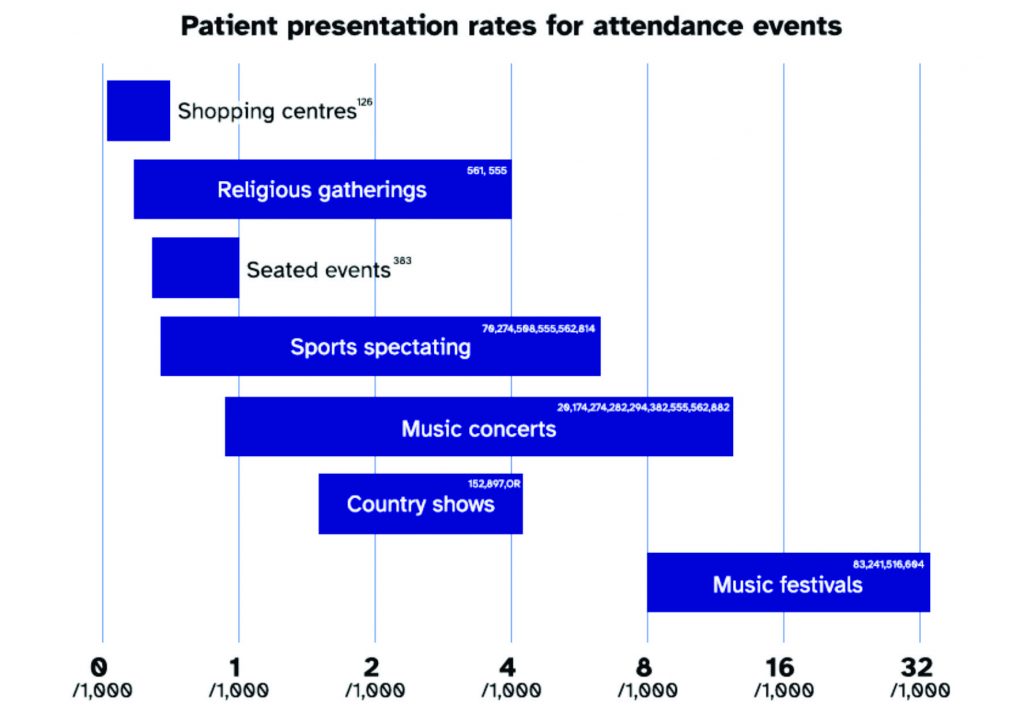
It can easily be shown that some events are just riskier than others.
A weakness of reference tables is that it usually treats a music concert and a music festival as being basically the same if they are for the same number of people, but that simply isn’t true – music festivals are up to 8x riskier than a concert playing similar music.
Medical providers need to have an accurate view of what the PPR for the particular event is.
Past history can be really helpful in understanding future rates, but even regular events can be impacted by changing variables, including:
- weather, and particularly temperature
- availability of free water
- usage rates of alcohol and drugs
- the music played – even down to the individual artist choices
Play it safe – book Lionel Richie
For music event organisers, the artist lineup is really important, but it doesn’t just affect ticket sales and reputation – it also impacts the likely number of people who’ll need medical help.
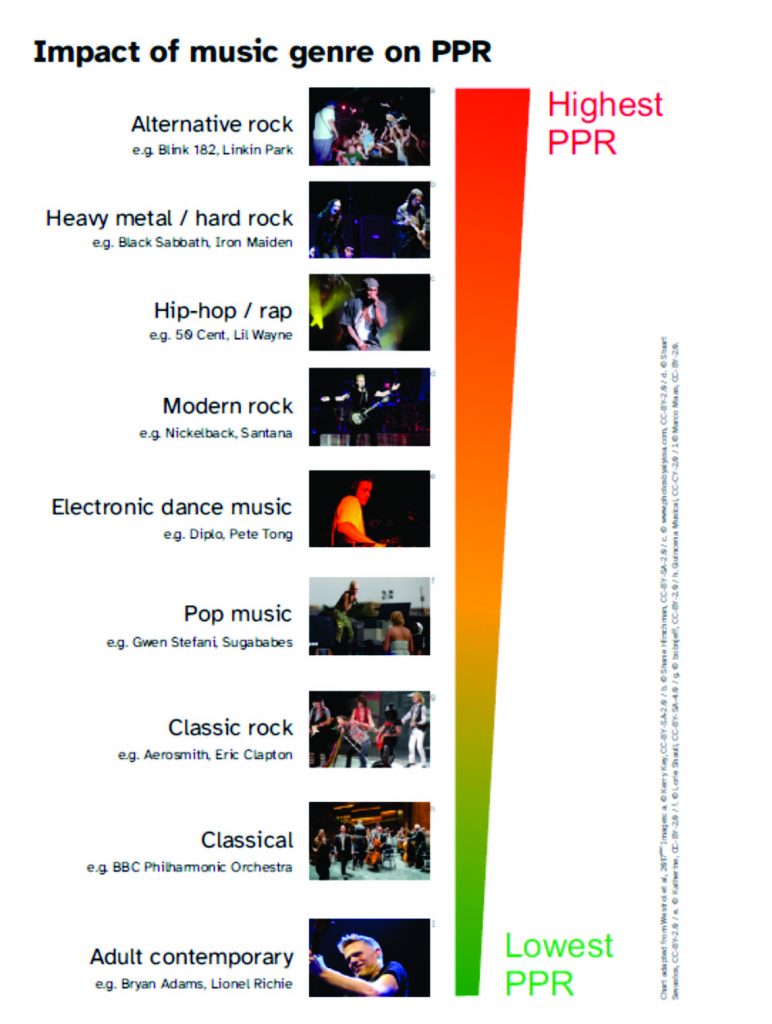
You might assume that classical music has the lowest rates – it isn’t an audience crowd known for crowd surfing and moshing – but actually adult contemporary artists like Lionel Richie or Bryan Adams actually see lower rates (likely to do with the amount of pre-existing conditions amongst typical classical music concert goers).
Even if you’re booking for a rock festival, there might be a huge difference to your medical cover if you book Nickelback rather than Aerosmith, and if Linkin Park are your headliner, you might want to put some extra cash aside for some more medical staff!
Calculating your numbers
Once you know the rate you expect, you can project an actual number of patients that you’re likely to see – but even that isn’t linear.
The next blog post will be about demand profiles, and why not every day of a music festival might need the same amount of medical cover.
Find out more
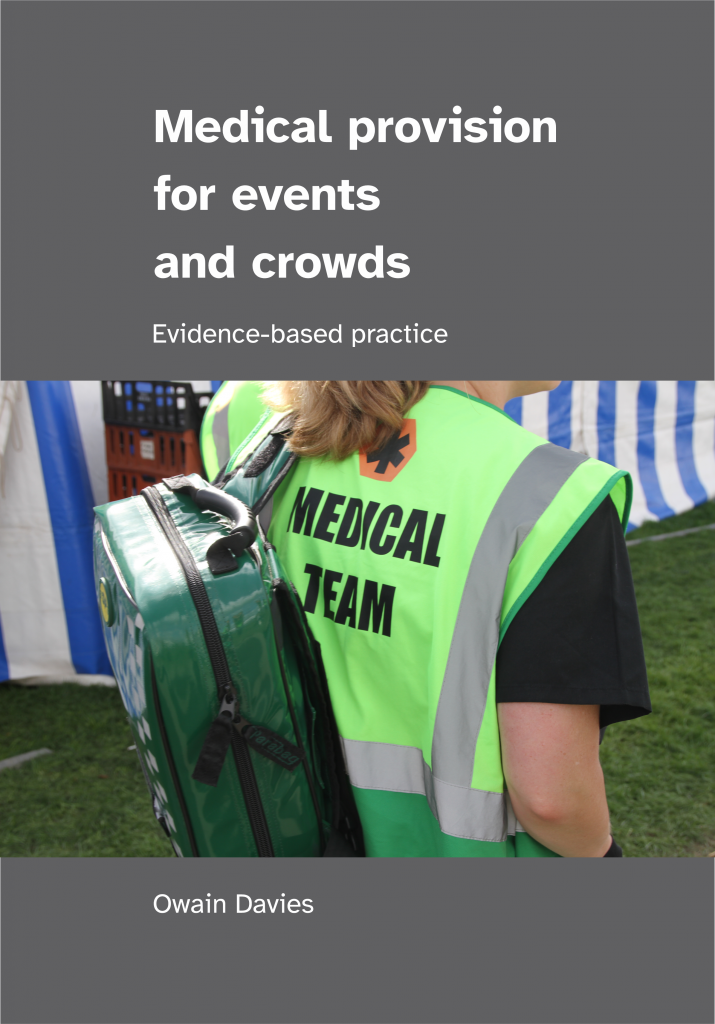
There is much more about how to properly conduct an evidence-based medical needs assessment in the textbook ‘Medical provision for events and crowds: Evidence-based practice‘, along with detailed reference data for dozens of event types. Available now on Amazon.
The book contains nearly 600 pages of evidence-based practice on the planning, standards, and delivery of medicine for events both during normal operations and for mass-casualty and major incidents.
Extensively researched and with nearly 1,000 peer-reviewed articles cited in-line, this is a one-of-a-kind reference book for every medical provider.
Leave a Reply