Heatwaves present some particular challenges for event organisers and for medical teams working at events. All events and medical providers need to make sure that they take suitable steps to safeguard their attendees.

Image (c) Mixtribe. CC-BY-2.0
What is a heatwave?
Heatwaves are defined by the Met Office as being when there are three or more consecutive days of hot weather. The UK Heat-health alert kicks in when temperatures reach 30°C by day and 15°C by night, but those temperatures aren’t necessary to declare a heatwave.
Heatwaves have a large-scale impact on morbidity and mortality – whether people become unwell and/or die – across the entire population, but affect vulnerable groups the most.
In most UK counties, there are now more than 12 days a year when the heat reaches 28°C or more, and most of these fall right in event season.
How does this impact events?
Put simply, higher temperatures mean that providers will see more patients presenting for care, and the impact isn’t small.
Every 1°C increase in temperature means a 10% increase in patients
Multiple peer-reviewed studies have shown a strong and replicable impact from higher environmental temperature.
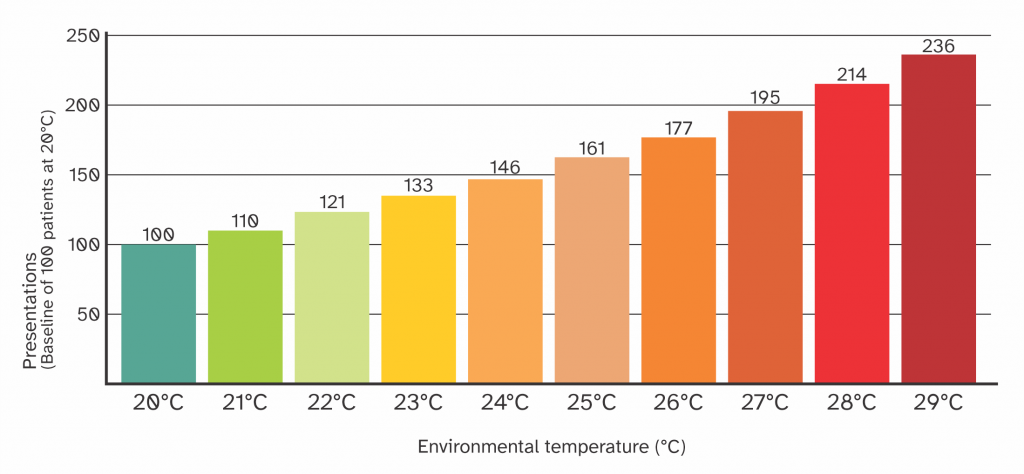
You can see from this plot that if the weather during an event is 28°C that the provider is likely to see more than double the number of patients compared to if the temperature was 20°C. That is a large difference to account for, and might need more staff, more equipment, and more consideration of specialist interventions.
It isn’t just heat-related presentations either – some seemingly unrelated problems are linked to heat. For instance, there is evidence that up to 1 in 5 mass-casualty crowd incidents are linked to high environmental temperature, or put more simply, there is a higher risk of a crowd crush or movement incident when it is hot.
Some events will have even bigger impacts because of where they are held. In particular, the ground surface can hugely increase the temperature and the patient presentation rate.
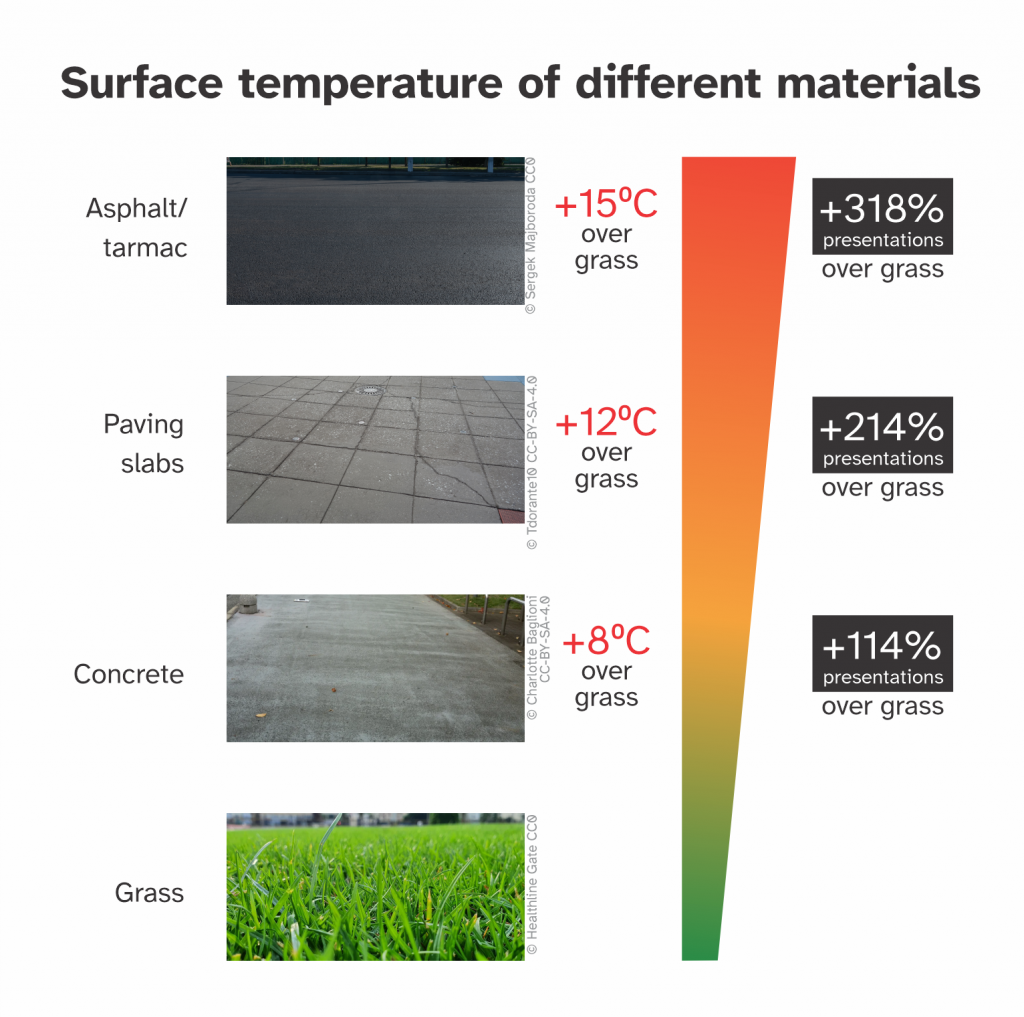
Grass is the best surface for managing heat, but the same event on tarmac might see the air temperature in the crowd increased by 15°C, which is then associated with more than tripling the number of patients.
For example, at one event where the air temperature was already 32°C, an organiser put down black plastic sheeting to help protect the grass, and this caused the air temperature in the crowd to spike to nearly 49°C, and caused a near-overwhelming number of patients to present to the medical team.
Who is affected?
It can be tempting to just think that heat affects a small number of people. Those people in frontline clinical practice often associate heat injury with older people, or maybe young children, who are those most likely to be impacted if they are at home, but far more people than this are affected.
Groups at risk include people who are:
– outside in sunlight for extended periods
– gathered in crowds
– dehydrated
– have consumed alcohol
– have consumed illegal drugs including cocaine, opioids, and MDMA
– are physically exerting themselves, like dancing
Does this sound like some events?
Events are very high risk for heat injury, and both events and medical providers need to be ready.
Clinical impact
The clinical impact on attendees can be quite wide ranging. Minor conditions include hear oedema, heat fatigue, sunburn, heat rash, and “Disney rash” (exercise-induced vasculitis).
At the more serious end, providers must be ready for exercise-associated collapse, heat exhaustion, heatstroke, and even malignant hyperthermia.
The highest risks are at events with the most exertion – particularly sporting events, and mass-gatherings with exertion like music festivals and concerts.
What providers need to do
Every medical provider, at every event, needs to consider heat injury, especially during a heatwave. Being a small event doesn’t make it less important.
Providers must ensure that they have suitable cooling methods, including for the most serious cases like heatstroke.
In heatstroke it is vital that cooling occurs quickly – faster than 0.15°C per minute. There are only a small number of techniques which can achieve this rate. Methods like ice vests, immersing the hands and feet in ice, and cold showers are NOT sufficient to cool people quickly enough.
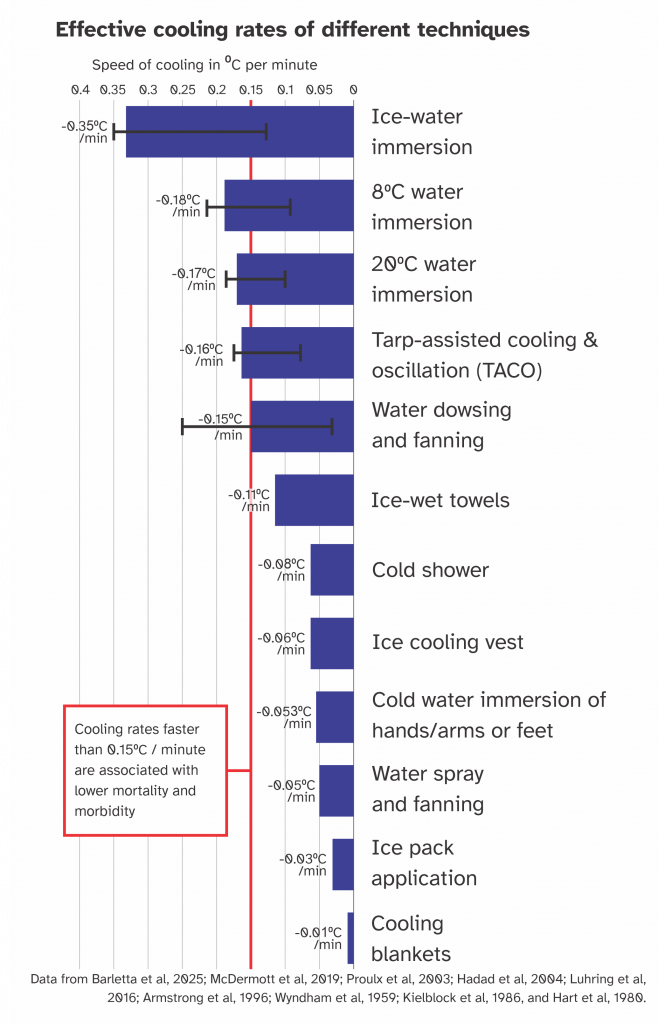
Even at small events, techniques like TACO (tarp-assisted cooling and oscillation) are both viable and cheap.
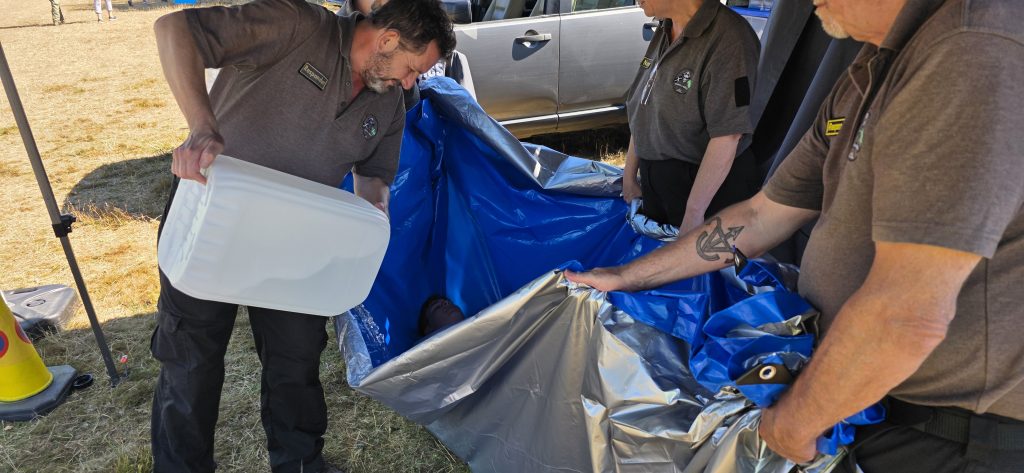
In addition, providers should be using rectal thermometry to assess core temperature. Every other technique is ineffective, and could mean cases are missed.
Find out more
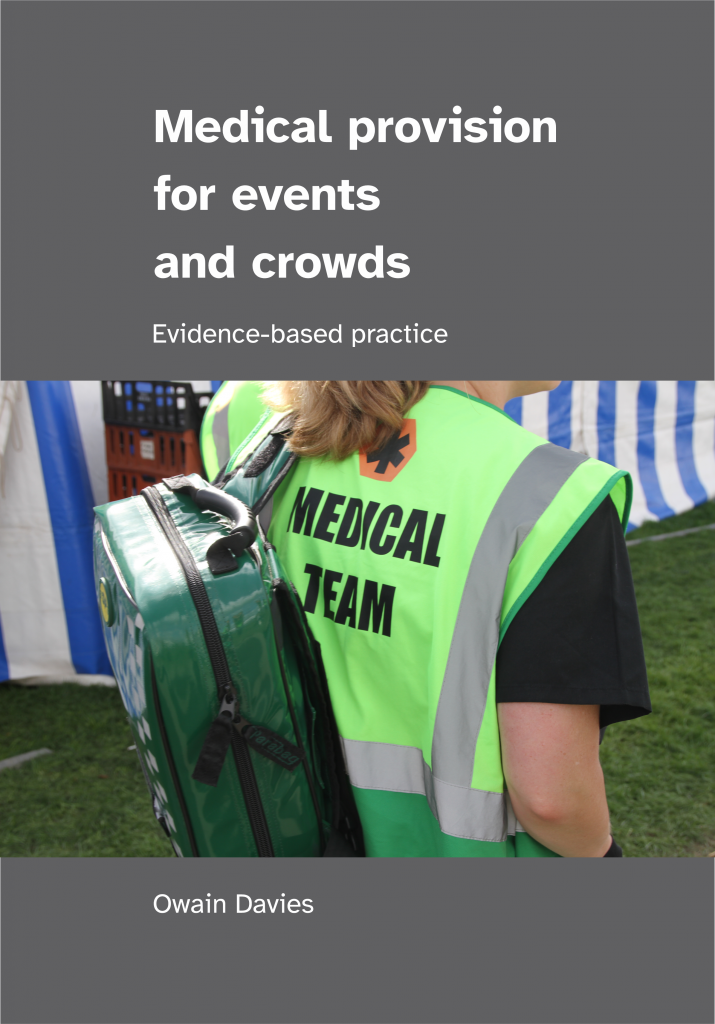
There is more about managing heat at events in the textbook ‘Medical provision for events and crowds: Evidence-based practice’. Available now on Amazon.
The book contains nearly 600 pages of evidence-based practice on the planning, standards, and delivery of medicine for events both during normal operations and for mass-casualty and major incidents.
Extensively researched and with nearly 1,000 peer-reviewed articles cited in-line, this is a one-of-a-kind reference book for every medical provider.
Leave a Reply