Organisers can often find themselves asking if getting medical cover is something they should be spending money on, and how much cover they might need.
When budgets are tight it can be tempting to find the cheapest possible quote. It should be fine – all medical providers are basically the same, right?
But this approach can have serious consequences for the unprepared or unlucky event organiser. Every organiser, no matter the size of the event – from village tea dance to city-sized music festival – has the same Duty of Care.
Duties of organisers
Organisers have legal, moral, and regulatory duties to fulfil. Some of these include:
- undertakings to get an event license from the local authority
- duties under the Health and Safety at Work Act 1974 towards their staff, volunteers, and contractors
- legal Duty of Care to attendees under the Occupiers Liability Acts
- the risk of liability under the Corporate Manslaughter and Corporate Homicide Act 2007 if it were to go wrong
- statutory duties under the Equality Act 2010, including towards groups like disabled people, pregnant mothers, older people, and children, who are all more likely to need first aid services than the general population
- liability for NHS costs under the Health and Social Care (Community Health and Standards) Act 2003 if the NHS needs to pick up the slack because of inadequate medical cover on site
- obligations under the Terrorism (Protection of Premises) Act 2025 to ensure a suitable response in the event of a worst-case scenario at your event
Alongside all of these run conditions imposed by event insurers and local governance groups like Safety Advisory Groups.
How to comply
Put simply, every organiser (and their nominated medical provider if they need one) needs to complete a medical needs assessment.
This sets out the basics of what medical help might be needed, and what resources are needed to fulfil the duties of the organiser.
Some small, low risk events will rightly assess that they aren’t likely to have anyone need first aid on an average event, and so won’t need dedicated cover. But they will still need some provision – even if its only a first aid kit, someone who is allocated to call emergency services if there is a problem, and a note of where the nearest public access defibrillator is.
Bigger, more complex, or higher risk events will need more resources – dedicated medical staff, a medical post, maybe ambulances or advanced resources.
Assessing medical needs
So how do you assess medical needs?
It starts with looking at the type of event, and the typical medical needs rate you can expect. This can be quite different depending on the type of event.
At quiet seated events, you might expect around 1 person per 1,000 attendees to need some sort of medical help, but at a music festival it’s more like 30 people in need per 1,000. Where people are actively taking part it’s often even higher, with marathons typically seeing 100 patients per 1,000 participants.
Lots of factors influence the rate, and these can make a big difference. Relevant impacts can be from:
- the type of event
- if the event is indoors or outdoors
- if the event has a controlled boundary, or is open for people to walk in and out
- the temperature and humidity during the event
- the availability of free drinking water
- the time of day, and the length of the event
- the levels of intoxication from alcohol and/or drugs
Organisers and medical providers need to take all of these factors (and some others) into account when planning how much medical cover is needed.
Finding out more
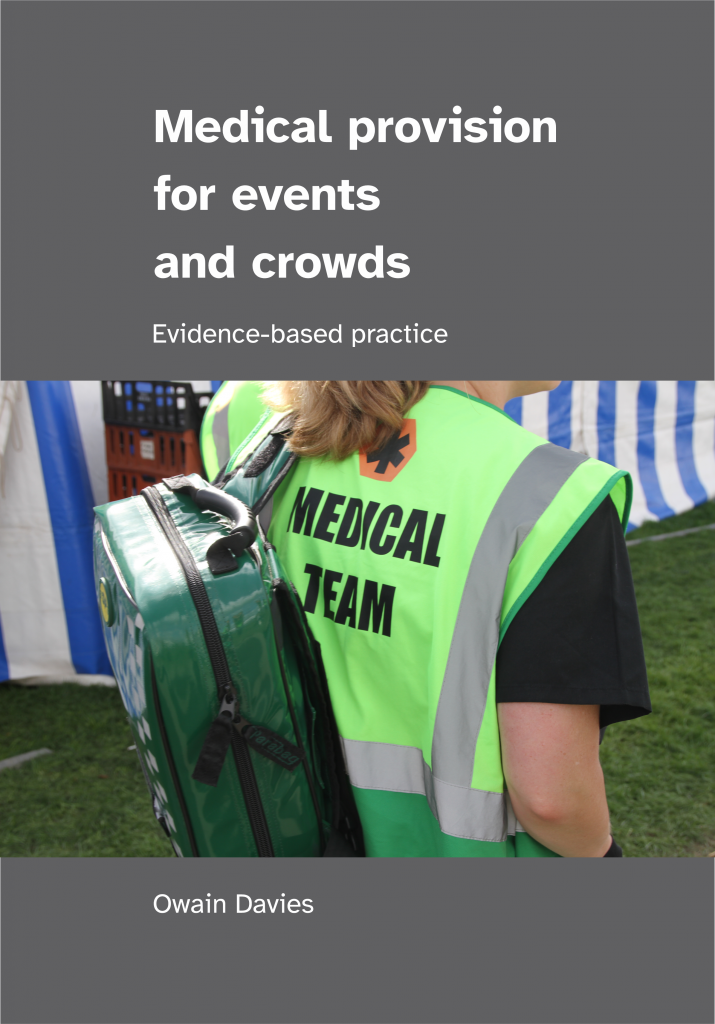
The book Medical provision for events and crowds: evidence-based practice is out now, and is the leading resource for people planning medical cover at an event.
Its available as an ebook and in hardcopy.
Leave a Reply